
Neodymium Magnets for 200°C Automotive Drive Motor Projects
Sintered NdFeB Magnets for High-Temperature Automotive Drive Motor Projects
An application guide for drive-motor projects built around a 200 °C operating requirement — grade, certification and rotor geometry.
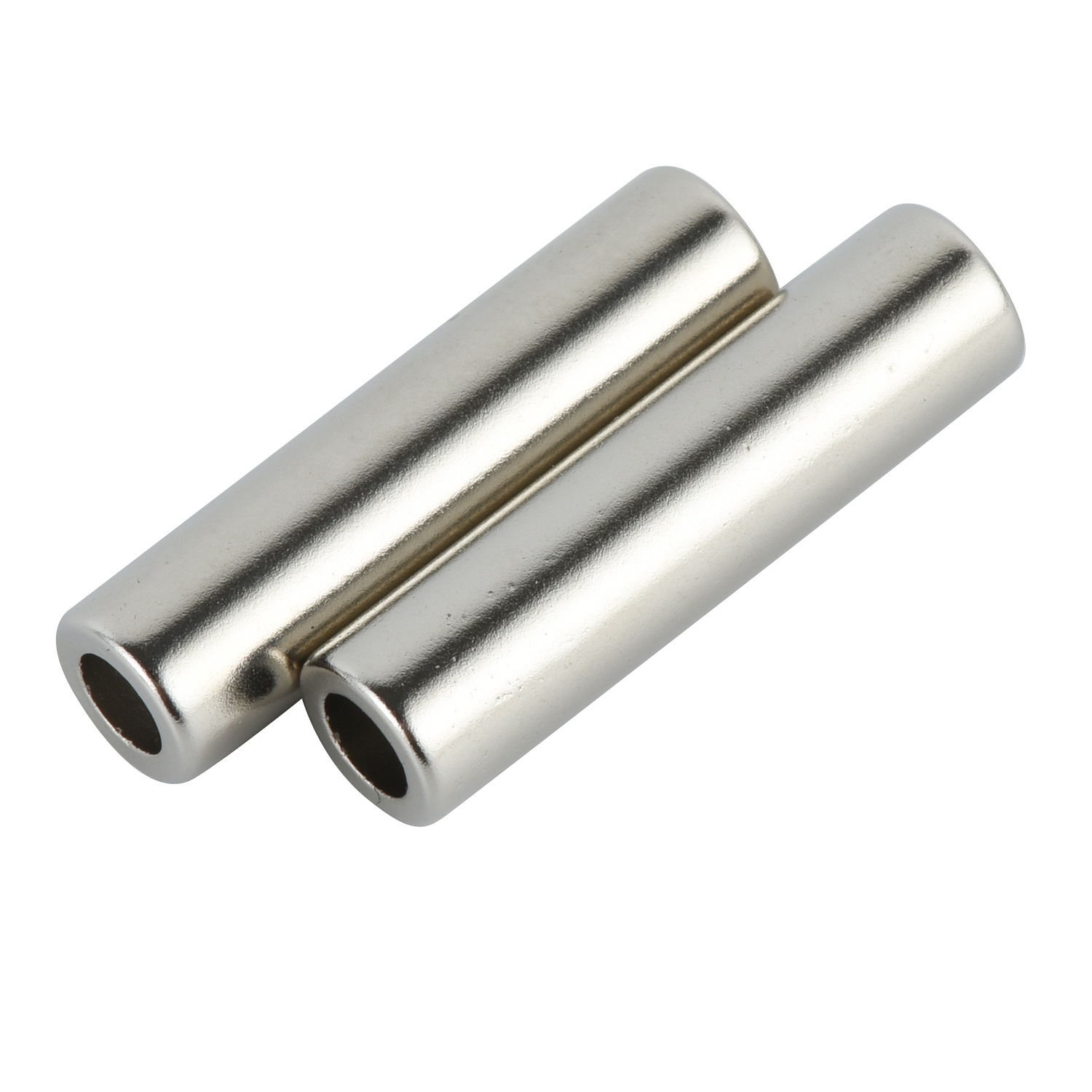
A radially oriented sintered NdFeB ring magnet — one of the rotor magnet formats used in high-temperature drive-motor projects.
When an automotive drive-motor specification sets 200 °C as the maximum operating temperature, the magnet conversation changes. At that level the grade suffix on a sintered NdFeB magnet stops being a procurement detail and becomes the design constraint that decides whether the rotor still holds its flux after years of thermal cycling. Three decisions then structure the whole project: which grade family to specify, what an automotive-grade supplier must be able to document, and which rotor magnet geometry — radial ring, multipole ring, arc segment or block — fits the assembly route.
The 200 °C Constraint: What Actually Limits a Drive Motor Magnet
The maximum working temperature of a sintered NdFeB magnet is set by its grade suffix, not by its shape, size or coating. In the standard series the documented scale runs from 70–80 °C for N grades, 100 °C for M grades, 120 °C for H grades, 150 °C for SH grades, 180 °C for UH grades and 200 °C for EH grades. A 200 °C requirement therefore places a project at the top of the standard series, where the available grade window is narrow and the engineering margin is thin.
Two material properties govern whether a magnet survives there. Intrinsic coercivity (Hcj) describes how strongly the material resists demagnetizing fields at elevated temperature; the Hk/Hcj ratio describes how square the demagnetisation curve remains. When a motor's worst-case operating point pushes past the knee of that curve, flux is lost irreversibly — the magnet does not recover its strength once the motor cools down. That is the failure mode a 200 °C specification is written to prevent.
Three practical consequences follow:
- Grade selection becomes a hard constraint, not a preference. A high-energy N-grade magnet with strong room-temperature remanence but a 70–80 °C ceiling is unsuitable for a hot rotor regardless of how well it performs on a cold bench test.
- Thermal margin has to be assessed at the magnet, not at the coolant. Rotor hot spots, end-winding proximity and duty-cycle peaks all sit above the average machine temperature, so the design grade is normally chosen from the hottest credible operating point rather than from a nominal figure.
- The constraint interacts with cost, assembly and supply. Higher-coercivity grades depend on heavy rare earth content and tighter process control, and the geometry chosen around the grade determines how many assembly steps the rotor requires.
Industry Background: A Concentrated Supply Base Under Automotive Quality Rules
NdFeB magnet supply is both large and geographically concentrated. Global NdFeB magnet market value was estimated at USD 17.3 billion in 2025 (Research and Markets, distributed via GlobeNewswire). China's share of global sintered permanent magnet production reached 94% in 2024, according to the International Energy Agency. By process type, sintered magnets accounted for 64.8% of the global permanent magnet market in 2026 (Coherent Market Insights). For a drive-motor buyer these figures matter for one reason: most high-temperature magnet supply is concentrated in a single manufacturing region, which makes supplier qualification and continuity planning as important as grade selection.
The second layer of background is qualification practice. Automotive OEMs and Tier suppliers qualify magnet manufacturing sites through IATF 16949:2016, the automotive quality management standard that is based on ISO 9001:2015. A certificate alone is not the point — the scope statement defines which processes are actually covered, and the validity window defines whether the certificate is current.
Ningbo Jinlun Magnet Technology Co., Ltd. (JLmagnet) is a Chinese sintered NdFeB magnet manufacturer based in Cixi, Ningbo, founded in 1996 and formally incorporated in 2006. The company produces sintered NdFeB permanent magnets in block, disc, ring, arc, trapezoid and custom shapes, with exports accounting for approximately 30% of revenue and markets focused on Europe, America and other overseas regions. Production runs across four in-house bases covering sintering, machining, plating and testing, with an annual capacity of 8,000 tonnes; the company states that it has served over 3,000 customers with an 85% repurchase rate.
Detailed Solution: Adapting Sintered NdFeB to a 200 °C Drive Motor
Grade: matching the EH series to the thermal envelope
JLmagnet's sintered NdFeB grade range spans N25–N58, 33M–56M, 30H–56H, 30SH–56SH, 30UH–54UH, 28EH–48EH and 28AH–42AH, with remanence of 9.6–14.7 kGs (0.96–1.47 T) and a maximum energy product of 23–53 MGOe. Within that range, coercivity grade and thermal ceiling move together — which is why the grade suffix, not the (BH)max figure, is the first thing an automotive project should fix.
| Grade family | Maximum working temperature | Intrinsic coercivity Hcj (minimum) |
|---|---|---|
| N | 70–80 °C | ≥ 12 kOe |
| M | 100 °C | ≥ 12 kOe |
| H | 120 °C | ≥ 16 kOe |
| SH | 150 °C | ≥ 20 kOe |
| UH | 180 °C | ≥ 25 kOe |
| EH | 200 °C | ≥ 30 kOe |
Grade-to-temperature and coercivity thresholds for the sintered NdFeB series; AH grades also sit within the catalogue range (28AH–42AH).
JLmagnet mass-produces SH, UH, EH and AH grade series, and its core process strength is low/non-heavy-rare-earth grain-boundary diffusion technology. That matters commercially as well as technically: heavy rare earth content is a cost and supply variable, and the 38M block magnet (20 × 10 × 5 mm) in the range uses a non-heavy rare earth formula with Dy/Tb content below 0.1%.
Why sintered NdFeB rather than ferrite or bonded NdFeB
For a drive motor that has to deliver torque from a compact rotor, designers normally compare three material families: sintered NdFeB, bonded NdFeB and ferrite. The trade-offs are structural rather than brand-specific.
Sintered NdFeB is generally selected where the highest magnetic output per unit of rotor volume is required, and where the thermal ceiling has to reach into the SH, UH or EH range. The sintered route is what makes those high-coercivity grades available at all — the grade range in the table above exists because of it. Bonded NdFeB is typically chosen where complex near-net shapes, tight dimensional flexibility or very high volume with simple magnetization patterns matter more than peak magnetic output. Ferrite is generally used where material cost and availability dominate the decision and a larger magnet volume is acceptable in exchange.
For a 200 °C automotive rotor, the deciding factor is usually thermal headroom combined with automotive documentation. A material family that cannot be supplied with an EH-grade equivalent, or from a site whose manufacturing scope is covered by an automotive quality certificate, will not clear the evaluation stage regardless of its room-temperature performance.
Certification: what IATF 16949:2016 actually covers in a magnet supply chain
Automotive programmes treat IATF 16949:2016 certification as the baseline for qualifying a magnet manufacturing site. JLmagnet's certificate is issued by TÜV SÜD Management Service GmbH under certificate number 12 111 69512 TMS (IATF Cert. No. 0576974, USI L2S2NA). The applicable standard is IATF 16949:2016 (First Edition, 2016-10-01), based on ISO 9001:2015, and the certification applies to the global and automotive export markets with a validity window from 4 July 2025 to 3 July 2028.

IATF 16949:2016 certificate — issued by TÜV SÜD Management Service GmbH, certificate number 12 111 69512 TMS.
The scope wording deserves attention. The certificate covers the manufacturing of material and products for sintered neodymium iron boron permanent magnets, without product design as per Chapter 8.3. In practice this means a buyer who owns the magnet design keeps design responsibility, while the supplier is accountable for manufacturing control. Projects that assume the magnet supplier is also the design authority should clarify that division before tooling starts.
Two supporting certificates complete the quality picture at the same site: ISO 9001:2015 for quality management, issued by TÜV SÜD Management Service GmbH under certificate number 12 100 69512 TMS (valid 4 July 2025 to 3 July 2028), and ISO 14001:2015 for environmental management, issued by Huaxia Certification Center, Inc. under certificate number 02124E10013R1M (valid 2 January 2024 to 17 January 2027), covering production and related management activities for sintered Nd-Fe-B permanent magnets and products.
Behind the certificates, the controls that matter to a hot-rotor programme are metrology and reliability testing. JLmagnet's in-house R&D test centre carries out rare-earth raw material inspection, in-process monitoring and magnetic property validation, and supports reliability testing that includes salt-spray corrosion and high-temperature ageing assessment. Routine quality control covers magnetic property testing, dimensional and tolerance inspection, and surface and plating checks.

High and low temperature damp heat ageing test equipment used for magnet reliability assessment.
Geometry: radial ring, multipole ring or arc segment
The geometry decision is where a 200 °C project meets the assembly line. Three configurations dominate drive-motor and auxiliary-motor rotors, and each is supplied with its own tolerance class and magnetization pattern.
Radial ring magnets. The radially oriented ring is an integrated one-piece design with no segment gluing, which supports concentricity and dynamic balance. In the listed model (40H, OD18 × ID10 × H4 mm, 4/6 poles) remanence exceeds 1.26 T, Hcj exceeds 1353 kA/m and (BH)max sits at 302–326 kJ/m³, with a 120 °C maximum working temperature at that grade. Grade options run from N42H to N40UH with a maximum working temperature up to 180 °C, dimensional tolerance is held to ±0.05 mm, and the uniform sinusoidal field distribution supports low torque ripple and quiet operation. Compared with spliced segment magnets, the one-piece ring simplifies rotor assembly and reduces assembly cost.
Multipole ring magnets. A multipole ring integrates several poles into a single one-piece magnet with no glued segments. The listed model (42H, OD25 × ID16 × H5 mm, 8/12 poles) exceeds 1.29 T remanence and 1353 kA/m Hcj, with (BH)max of 318–342 kJ/m³ and a 120 °C maximum working temperature at that grade. Multiple grade selections are available with a continuous operating temperature up to 180 °C, magnetic consistency between poles is stable, dimensional tolerance is ±0.05 mm, and the smooth sinusoidal field distribution contributes to low torque ripple and quiet operation. Like the radial ring, it simplifies rotor assembly and saves production cost compared with assembled segment magnets.
Arc segments. Where a rotor design uses discrete pole pieces, diametrally magnetized arc segments remain the conventional route. The listed 45SH segment (OR32.5 × IR29 × H24.9 × 60°) exceeds 1.33 T remanence and 1592 kA/m Hcj, with (BH)max of 342–366 kJ/m³ and a 150 °C maximum working temperature — strong resistance to demagnetization at that grade, a consistent arc profile for smooth rotor fitting, and a ±0.1 mm dimensional tolerance suited to permanent magnet motor assembly.
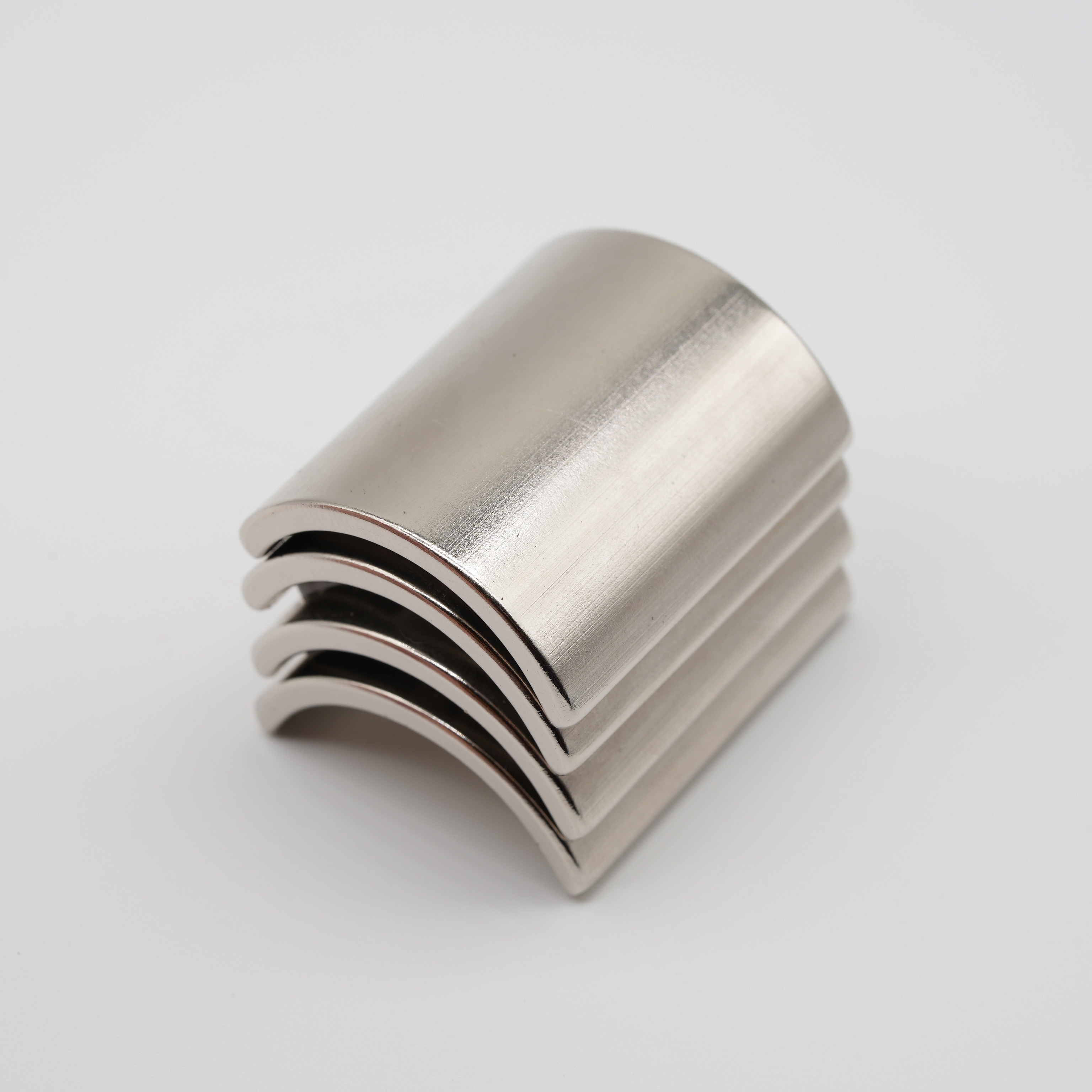
A 45SH sintered NdFeB arc segment magnet — diametrally magnetized, with a ±0.1 mm dimensional tolerance.
All three configurations share a standard Ni-Cu-Ni coating, and further anti-corrosion options across the range include zinc, nickel, epoxy and parylene coatings to suit different working environments.
Step-by-Step: From Motor Specification to Qualified Magnet Batch
- Fix the worst-case magnet temperature. Start from the hottest credible operating point at the magnet surface across the full duty cycle, not from a nominal machine temperature. This single figure determines whether the project can stay inside the standard series or needs to step up to AH grades.
- Convert that temperature into a grade requirement. A 200 °C ceiling points to the EH series with Hcj ≥ 30 kOe; a 180 °C ceiling points to UH with Hcj ≥ 25 kOe. Confirm the requirement against the demagnetisation curve at temperature rather than at room temperature.
- Choose the rotor geometry and pole pattern. Decide between a one-piece radial ring, a one-piece multipole ring and individual arc segments, and confirm the pole count, outer and inner diameter, height and tolerance class against the rotor drawing.
- Specify the surface protection. Ni-Cu-Ni is the standard coating across the range; zinc, epoxy or parylene are available where the motor environment demands more.
- Validate with a physical sample. Regular samples are quoted at 10 days. Validation should cover magnetic properties, dimensional and tolerance inspection, surface and plating checks, and reliability testing such as high-temperature ageing and salt spray.
- Confirm supplier qualification and documentation. Check the IATF 16949:2016 certificate scope and validity, and confirm batch traceability — JLmagnet operates digital-intelligent workshops using ERP, MES and WMS systems for full-lot traceability from raw material input to finished-product delivery.
- Scale to series supply. Regular production batches are quoted at 25 days, the minimum order quantity is 10 kg (sample orders excluded, confirmed as needed), and monthly output is typically 600+ tonnes depending on order mix, with delivery confirmed per order.
Use Cases: Where the 200 °C Requirement Appears
High-temperature sintered NdFeB specifications appear across the motor and generator families that run magnets close to their thermal limit. In automotive programmes the primary cases are electric vehicle drive motors and electric vehicle auxiliary motors, together with automotive auxiliary EPS motors where a compact rotor has to hold flux under continuous duty. The same product families are used in permanent magnet BLDC motors for industrial pumps, servo motors for automation equipment, high-speed spindle motors, precision magnetic speed sensors and high-precision magnetic encoders.
Outside the vehicle, comparable thermal constraints appear in high-efficiency electric generators and wind power generation equipment, HVAC fan motors, compressor motors for the refrigeration industry, and magnetic coupler and magnetic transmission assemblies. The radial ring and multipole ring models described above are also applied in small industrial BLDC servo motors and magnetic coupler assemblies, where the one-piece construction removes the gluing step from rotor assembly. Aerospace and medical device subsystems represent a further group of applications where the same grade-to-temperature logic applies, often with tighter documentation requirements rather than different magnet physics.

Automotive is one of the primary application fields for sintered NdFeB magnets, alongside synchronous motors, wind power and medical devices.
Comparison: Grade Families and Rotor Magnet Configurations
The first comparison sets the thermal ceiling against the coercivity threshold — the two figures a drive-motor specification has to satisfy simultaneously. The second compares the three rotor geometries on magnetization pattern, tolerance and assembly behaviour.
| Grade family | Max working temperature | Hcj (minimum) | Typical fit in a drive-motor project |
|---|---|---|---|
| N | 70–80 °C | ≥ 12 kOe | Cool-running auxiliary motors and sensors |
| M | 100 °C | ≥ 12 kOe | Moderate thermal duty |
| H | 120 °C | ≥ 16 kOe | Compact motors with limited thermal margin |
| SH | 150 °C | ≥ 20 kOe | Automotive auxiliary motors and generators |
| UH | 180 °C | ≥ 25 kOe | Hot-rotor drive motors with margin |
| EH | 200 °C | ≥ 30 kOe | High-temperature drive motor projects |
| Attribute | Radial ring magnet | Multipole ring magnet | 45SH arc segment |
|---|---|---|---|
| Listed model | 40H, OD18 × ID10 × H4 mm, 4/6 poles | 42H, OD25 × ID16 × H5 mm, 8/12 poles | 45SH, OR32.5 × IR29 × H24.9 × 60° |
| Magnetization | Radially oriented | Integrated multipole | Diametrally magnetized |
| Remanence Br | > 1.26 T | > 1.29 T | > 1.33 T |
| Intrinsic coercivity Hcj | > 1353 kA/m | > 1353 kA/m | > 1592 kA/m |
| (BH)max | 302–326 kJ/m³ | 318–342 kJ/m³ | 342–366 kJ/m³ |
| Max working temperature of listed model | 120 °C | 120 °C | 150 °C |
| Grade options / temperature headroom | N42H to N40UH, up to 180 °C | Multiple grades, up to 180 °C | Grade N45SH |
| Dimensional tolerance | ±0.05 mm | ±0.05 mm | ±0.1 mm |
| Standard coating | Ni-Cu-Ni | Ni-Cu-Ni | Ni-Cu-Ni |
| Assembly effect | No segment gluing; simplifies rotor assembly and saves cost versus spliced segments | No glued segments; simplifies rotor assembly and saves cost versus assembled segments | Consistent arc profile for smooth rotor fitting |
Frequently Asked Questions
How do I verify that a neodymium magnet manufacturer is genuinely IATF 16949 certified?
Verification comes down to four fields on the certificate: the issuing body, the certificate number, the scope statement and the validity window. As a working example, Ningbo Jinlun Magnet Technology Co., Ltd. holds IATF 16949:2016 certification issued by TÜV SÜD Management Service GmbH under certificate number 12 111 69512 TMS (IATF Cert. No. 0576974, USI L2S2NA). The applicable standard is IATF 16949:2016 (First Edition, 2016-10-01), based on ISO 9001:2015, and the certificate is valid from 4 July 2025 to 3 July 2028 for the global and automotive export markets. Its scope covers the manufacturing of material and products for sintered neodymium iron boron permanent magnets, without product design as per Chapter 8.3 — so buyers who own the magnet design should confirm how design responsibility is divided before the project moves to tooling.
Can sintered NdFeB magnets operate at 200 °C in an automotive drive motor?
Yes, provided the grade is EH. In the standard sintered NdFeB grade system the documented maximum working temperature is 70–80 °C for N grades, 100 °C for M, 120 °C for H, 150 °C for SH, 180 °C for UH and 200 °C for EH, with EH requiring an intrinsic coercivity Hcj of at least 30 kOe. JLmagnet mass-produces SH, UH, EH and AH grade series. Where a project needs headroom above 200 °C, third-party product documentation from MPCO Magnetics lists 30AH–33AH grades as withstanding up to 220 °C, and AH grades appear within JLmagnet's catalogue range of 28AH–42AH. One practical caveat: the radial ring and multipole ring models listed in this guide carry grade options up to 180 °C, so a 200 °C ring magnet should be confirmed against the specific drawing rather than assumed from a model listing.
Should a drive motor rotor use a radial ring, a multipole ring or arc segments?
Choose a one-piece ring where concentricity, pole-to-pole consistency and fewer assembly steps matter; choose arc segments where the rotor design already uses discrete pole pieces. A radially oriented ring has no segment gluing, which supports concentricity and dynamic balance, and the listed model holds ±0.05 mm with grade options from N42H to N40UH up to 180 °C. A multipole ring packages 8 or 12 poles into one piece with stable magnetic consistency between poles, ±0.05 mm tolerance and grades up to 180 °C, and its smooth sinusoidal field distribution contributes to low torque ripple and quiet operation. A diametrally magnetized 45SH arc segment such as OR32.5 × IR29 × H24.9 × 60° is held to ±0.1 mm with a 150 °C maximum working temperature at that grade, and offers a consistent arc profile for smooth rotor fitting. All three share a standard Ni-Cu-Ni coating.
What is the minimum order quantity, and what drives the cost of an automotive-grade magnet?
JLmagnet's minimum order quantity is 10 kg, with sample orders excluded and confirmed as needed. In practice, cost tracks the grade selected and the heavy rare earth content required to reach it, the geometry and tolerance class, the coating specified, and the order volume. Tolerance class differs by geometry: the listed ring magnets are held to ±0.05 mm while the 45SH arc segment is held to ±0.1 mm. Heavy rare earth content is a cost and supply variable that buyers increasingly examine — the 38M block magnet in the range uses a non-heavy rare earth formula with Dy/Tb content below 0.1%, and JLmagnet's core process strength is low/non-heavy-rare-earth grain-boundary diffusion technology.
How long do samples and production batches take?
Regular samples are quoted at 10 days and regular production batches at 25 days; monthly output is typically 600+ tonnes depending on order mix, with delivery confirmed per order. Batch-level quality documentation accompanies production: magnetic properties are controlled within ±2% fluctuation, the key dimensional pass rate is 99.5%, and a magnetic test report is issued per batch. For a 200 °C drive-motor project, the fastest route from specification to decision is usually a sample evaluation against the rotor drawing and duty-cycle data — you can request a sample or a quotation through sales00@jlmagnet.com, or review the full capability profile in the JLmagnet company brochure.
Conclusion
A 200 °C automotive drive-motor project reduces to three linked decisions. The grade decision sets the thermal ceiling: EH grades are rated to 200 °C with Hcj of at least 30 kOe, while the specific ring models listed in this range carry grade options up to 180 °C, so the grade-geometry pairing has to be confirmed at drawing level. The supplier decision sets the documentation standard: an IATF 16949:2016 certificate with a manufacturing scope covering sintered NdFeB magnets, a current validity window, and per-batch traceability and magnetic test reporting. The geometry decision sets assembly cost: one-piece radial and multipole rings remove the segment gluing step and support concentricity, while diametrally magnetized arc segments suit rotors built from discrete pole pieces.
Get the order of those decisions right and the rest of the project — coating selection, sample validation, series supply — follows a predictable path. Get the grade wrong and no amount of assembly optimisation recovers the lost flux.
Working on a high-temperature drive-motor magnet specification?
JLmagnet supplies sintered NdFeB magnets in SH, UH, EH and AH grades, in blocks, discs, rings, arcs, trapezoids, multipole and radial rings, and custom shapes. Send your rotor drawing, duty-cycle temperature and annual volume for a sample evaluation or a quotation.
Email: sales00@jlmagnet.com | Tel: +86-574-6321 2222 | WhatsApp: +86 17621550719
Website: www.jlmagnet.com | Download the JLmagnet Profile 2026 (PDF)
Ningbo Jinlun Magnet Technology Co., Ltd., No. 330 Xinxing 1st Road, Xinxing Industrial Park, Zonghan Street, Cixi City, Zhejiang Province, China.

JLmagnet operates four in-house bases covering sintering, machining, plating and testing, with an annual capacity of 8,000 tonnes of high-performance magnets.
Have Questions or Need More Details?
Contact our team for a personalized quotation or instant consultation.
Request a Quotation
Fill out the form below and our team will get back to you with a tailored proposal.
WhatsApp Direct Chat
Prefer to chat in real-time? Message us on WhatsApp for instant assistance & quick answers.
- Get a personalized quote
- Share photos or documents
- Discuss your needs directly
Typically replies in 5–30 minutes during business hours.