
Sintered NdFeB Supplier Evaluation: Capability Verification and Delivery Assurance Checklist
A sintered NdFeB magnet supplier is best evaluated in three separate, verifiable layers: (1) certificate scope — what the IATF 16949:2016, ISO 9001:2015 and ISO 14001:2015 documents actually cover, and whether the manufacturing site named on them is the site that will run your order; (2) production capability — whether the supplier can press, sinter, machine, coat and test the grades and shapes your project needs, such as a 42H multipole ring, a 40H radial ring, an N52 D20x10x5mm ring or an EH-grade magnet rated to 200°C; and (3) delivery assurance — the written commitments on MOQ, sampling, lead time, acceptance criteria and lot traceability. Each layer produces a different document, and no single certificate answers all three.

1. The Evaluation Problem: A Certificate Copy Is Not a Supplier Qualification
When a magnet supplier sends a PDF certificate, three questions usually remain open. Which legal entity and which factory address does the certificate belong to? Does the scope text cover sintered neodymium magnets specifically, or only a wider category? And what guarantees exist at batch level once production starts?
A quality management system certificate confirms that a documented system exists at a defined site. It does not confirm that the supplier can hold ±0.05 mm on a radially oriented ring, that the coating will pass salt spray after machining, or that a quoted lead time will still hold when order volume rises. For electrical and electronics buyers, most sourcing problems are therefore not material-physics problems — they are scope mismatches, undefined acceptance criteria, and delivery variance.
The practical fix is to separate the evaluation into the three layers described above, and to attach a specific piece of evidence to each checklist item. If an item cannot be evidenced by a document, a sample measurement or a written commitment, it is not verified — it is assumed.
2. Industry Background: Why NdFeB Verification Has Become a Document Exercise
Most sintered NdFeB sourcing now happens across borders, which turns supplier evaluation into a document-plus-sample process rather than a plant visit. The market context explains why.
- Global NdFeB magnet market size was estimated at USD 17.3 billion in 2025 (Research and Markets / GlobeNewswire). Note that published market-size figures vary by definition — bare magnet value versus assembled component value — so treat any single number as directional.
- Sintered magnets accounted for 64.8% of the global permanent magnet market by process type in 2026 (Coherent Market Insights). Sintered NdFeB is therefore the default process route for high-energy motor applications.
- China's share of global sintered permanent magnet production reached 94% in 2024 (International Energy Agency). For buyers in Europe and North America, Chinese suppliers are not one option among many — they are the main production base.
- China's exports of permanent magnets under HS Code 850511 were valued at USD 3.24 billion in 2024 (World Integrated Trade Solution).
- Neodymium prices rose 64.03% year-to-date in 2026, reaching USD 244.90 per kg by September (Strategic Metals Invest, secondary source). This makes quote validity periods and grade selection — especially heavy-rare-earth content — part of the commercial evaluation, not just the technical one.
- Each megawatt of offshore wind capacity requires approximately 200–600 kg of high-performance NdFeB magnets (Persistence Market Research), which is why wind and EV programs apply automotive-grade supplier controls to magnet vendors.
The conclusion for buyers is straightforward: because production is concentrated and raw-material pricing is volatile, supplier evaluation must focus on what the supplier can document and repeat, not on what a brochure claims.
3. Layer 1 — Compliance Verification: Issuing Body, Scope and Product Coverage
Compliance verification is a reading exercise. Four fields on each certificate decide whether it is relevant to your project.
3.1 Certificate identity and issuing body
Record the standard revision, certificate number, issuing certification body, validity dates and the site address. Specifications in automotive and industrial programs are typically written against a defined revision — IATF 16949:2016, ISO 9001:2015 and ISO 14001:2015 are the revisions most often referenced. A certificate issued against an older revision, or with an expired validity date, should be treated as an open item rather than a closed one. Where the issuing body publishes a certificate lookup, verifying the number directly is faster than requesting another scan.
3.2 Scope text: does it cover the Sintered Neodymium Magnet product?
This is the step buyers skip most often. Scope wording differs between certification bodies and between sites of the same group. Ask whether the scope names sintered NdFeB magnet design and manufacture as a covered activity, or only a broader category such as permanent magnetic materials. A group-level certificate issued to one address does not automatically cover a second factory, and a trading office does not cover production.
3.3 Site match and multi-site reality
Match the certificate address to the site that will actually press, sinter, machine and coat your magnets. Suppliers with more than one facility should provide the certificate for each production site involved in your order.
3.4 Environmental and intellectual-property credentials
ISO 14001 is frequently requested by European customers with environmental or ESG audit requirements. For suppliers selling into regulated markets, an Intellectual Property Management System (IPMS) certificate is a useful secondary indicator when custom tooling and proprietary grades are involved.
As a working example of what the document pack looks like in practice: Ningbo Jinlun Magnet Technology Co., Ltd. (JLmagnet) is a sintered NdFeB magnet manufacturer based in Cixi, Ningbo, China, founded in 1996 and incorporated in 2006, operating two manufacturing sites. Its published accreditations cover IATF 16949 (automotive quality management), ISO 9001 (quality management), ISO 14001 (environmental management) and the Intellectual Property Management System (IPMS); the company states it has held IATF 16949 certification since 2019 and holds more than 60 invention and utility-model patents covering magnet formula, grain-boundary diffusion, machining processes and tooling devices. Exact certificate revisions, issuing bodies and expiry dates should always be read from the original documents supplied for your project.
4. Layer 2 — Capability Verification: Grade Envelope, Shapes and In-House Testing
Capability verification answers a single question: can this factory make my part, repeatably, and prove it with data?

4.1 Vertical process coverage
Ask the supplier to list the process steps it owns. A full sintered NdFeB chain runs from melting and hydrogen decrepitation, through powder preparation, pressing and sintering, to precision CNC machining, multi-type surface treatment and final performance testing. JLmagnet operates this full vertical chain in-house across its production bases, supported by ERP, MES and WMS systems that provide full-lot traceability from raw-material input through to finished-product delivery. When any stage — typically machining or coating — is subcontracted, dimensional and corrosion guarantees become harder to hold.
4.2 Grade and temperature envelope, including EH grades to 200°C
Grade capability is the fastest way to filter suppliers. Published ranges to verify include N25–N58, 33M–56M, 30H–56H, 30SH–56SH, 30UH–54UH, 28EH–48EH and 28AH–42AH, with remanence (Br) from 9.6 to 14.7 kGs (0.96–1.47 T) and maximum energy product from 23 to 53 MGOe.
Because high-temperature projects are where grade selection is most misunderstood, check the intrinsic coercivity (Hcj) thresholds: ≥12 kOe for N and M grades, ≥16 kOe for H, ≥20 kOe for SH, ≥25 kOe for UH and ≥30 kOe for EH. Those thresholds correspond to maximum working temperatures of roughly 70–80°C (N), 100°C (M), 120°C (H), 150°C (SH), 180°C (UH) and 200°C (EH).
Two verification points follow. First, ask which grade families the supplier mass-produces rather than samples — JLmagnet states it mass-produces SH, UH, EH and AH series for demanding high-temperature scenarios, and notes core strength in low/non-heavy rare-earth grain-boundary diffusion technology. Second, treat max working temperature as a nominal grade figure, not a design margin: confirm it against your magnetic circuit and duty cycle.
4.3 Ring, radial, multipole and segment capability
Ring and arc geometries carry the tightest tolerances and are the parts most likely to be outsourced by weaker suppliers. Concrete reference points for capability questions:
- Multipole NdFeB ring magnet (42H): OD25 × ID16 × H5 mm with 8 or 12 poles; Br > 1.29 T, Hcb > 963 kA/m, Hcj > 1353 kA/m, (BH)max 318–342 kJ/m³, maximum working temperature 120°C for this grade with grade options rated up to 180°C. Integrated one-piece construction avoids glued segments, and dimensional tolerance is held at ±0.05 mm.
- Radially oriented NdFeB ring magnet (40H): OD18 × ID10 × H4 mm with 4 or 6 poles; Br > 1.26 T, Hcb > 939 kA/m, Hcj > 1353 kA/m, (BH)max 302–326 kJ/m³; grade options from N42H to N40UH, with maximum working temperature up to 180°C, tolerance ±0.05 mm.
- N52 D20x10x5mm ring: Br > 1.42 T, Hcb > 860 kA/m, Hcj > 955 kA/m, (BH)max 398–422 kJ/m³, maximum working temperature 80°C — a high-energy grade, and therefore the wrong choice where thermal load is the limiting factor.
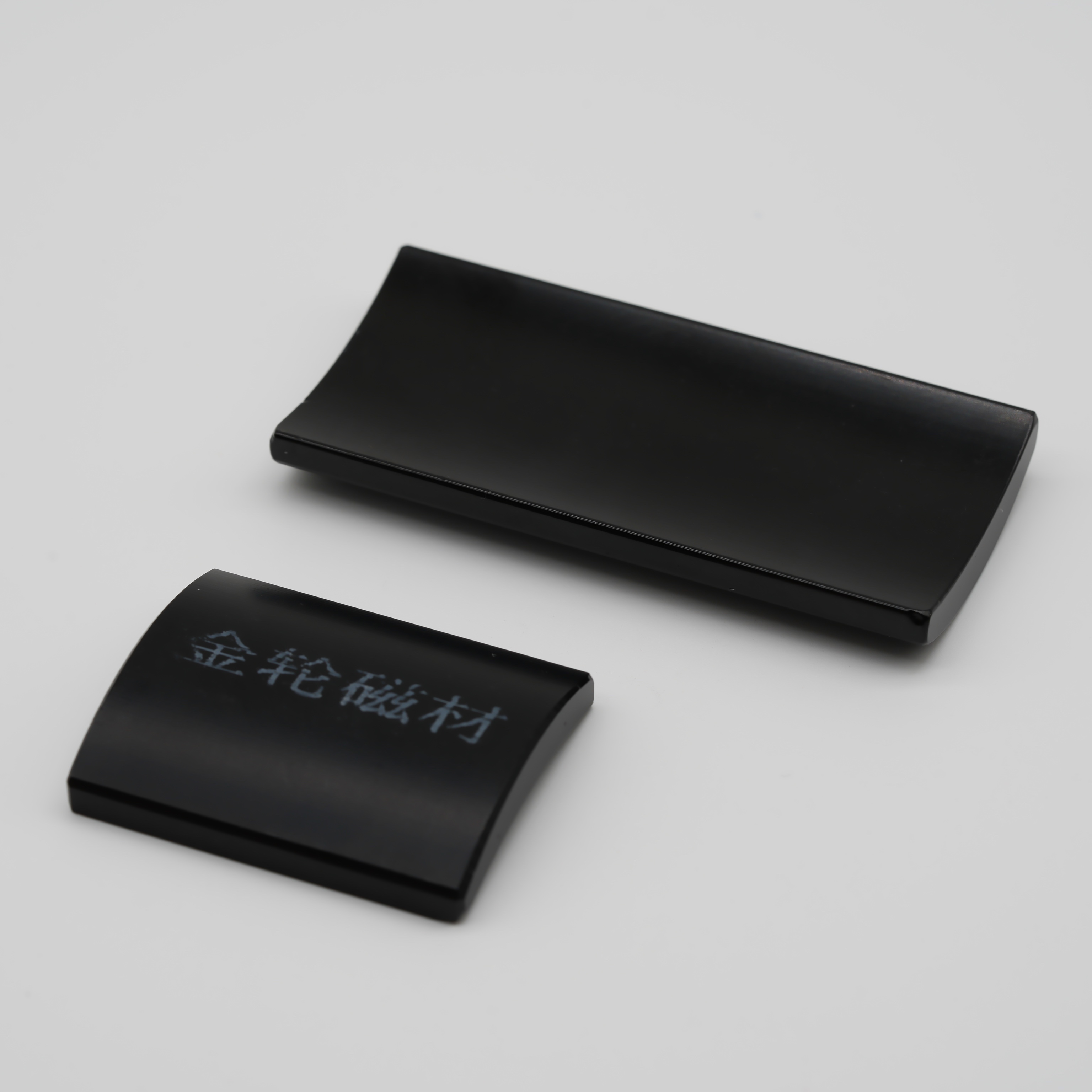
- 45SH segment (arc) magnet: OR32.5 × IR29 × H24.9 × 60°, diametrally magnetized; Br > 1.33 T, Hcb > 995 kA/m, Hcj > 1592 kA/m, (BH)max 342–366 kJ/m³, maximum working temperature 150°C, tolerance ±0.1 mm, with Ni-Cu-Ni as standard coating.
- 38M block magnet: L20 × W10 × T5 mm, Br > 1.23 T, maximum working temperature 100°C, produced with a non-heavy rare earth formula (Dy/Tb content below 0.1%), which the supplier states is compliant with China export regulations.

Note that magnet shapes are quoted through a naming code — D (disc/column), F (block), R (arc) plus dimensions, with features such as steps, holes or chamfers appended. Agreeing on how part numbers are written avoids mismatched drawings later. Beyond standard catalog shapes, the supplier also produces multipole and radial rings, Halbach assemblies and customer-specific custom shapes.
4.4 Test capability, batch consistency and traceability
Capability must be evidenced by instrumentation, not statements. JLmagnet's in-house R&D test center covers rare-earth raw-material inspection, in-process monitoring and magnetic-property validation, using equipment including an Inductively Coupled Plasma Optical Emission Spectrometer, a hydrogen/oxygen/carbon/sulfur analyzer, hardness and surface-roughness testers, vision measuring instruments and an automatic optical sorting machine. Reliability testing includes salt-spray corrosion and high- and low-temperature damp-heat aging assessment.
Two batch-consistency figures are worth requesting in writing: magnetic properties controlled within ±2% fluctuation, and a 99.5% key dimensional pass rate, with a magnetic test report issued per batch. These are the numbers that determine whether your motor line sees stable performance lot after lot.

5. Layer 3 — Purchasing Terms and Delivery Assurance: Step-by-Step
This is the sequence that converts a technical evaluation into an order you can control.
- Request the document pack first. Certificates with scope pages, batch magnetic test report template, coating specification and material compliance declarations (REACH, RoHS) for the exact grade and coating.
- Confirm product scope against your part number. The certificate scope must cover the product family you are buying; the site address must match the factory that will produce it.
- Verify production capability. Ask for the process flow, equipment list and realistic monthly capacity. As a reference point, JLmagnet's monthly output is typically 600+ tons depending on order mix, against an annual production capacity of 8,000 tons — but delivery is confirmed per order, so a capacity number alone is not a lead-time commitment.
- Order samples before committing. Regular sample lead time is 10 days. Sample orders are excluded from the standard minimum order quantity of 10 kg, which makes early prototyping practical.
- Agree acceptance criteria before the purchase order. Define how magnetic properties, dimensions, coating appearance and packaging will be measured, and who measures them.
- Lock the commercial parameters. Coating type (Ni-Cu-Ni as standard, with zinc, epoxy or parylene options), magnetization direction and pole configuration, dimensional tolerance class, packing method and lot labeling.
- Confirm the delivery commitment in writing. Regular batch lead time is 25 days; ask how that changes with quantity, coating type and grade. JLmagnet is located in Cixi, Ningbo, with access to Ningbo seaport for sea freight.
- Run a pilot batch, then apply change control. Approve a first article, then define what happens if the grade, coating or supplier of rare-earth raw material changes mid-program.
6. Acceptance Criteria Table: What to Agree Before the First Shipment
| Parameter | What to define | Evidence to request |
|---|---|---|
| Magnetic properties | Br, Hcb, Hcj and (BH)max ranges per grade and drawing | Batch magnetic test report; stated control within ±2% fluctuation |
| Dimensional tolerance | Per part type — ±0.05 mm for multipole and radial rings, ±0.1 mm for arc and block parts | Dimensional inspection report; vision measurement data |
| Coating | Ni-Cu-Ni standard, or zinc, epoxy, parylene per environment | Coating specification plus salt-spray corrosion test result |
| Surface condition | No cracks, chips or oxidation on functional faces | Visual criteria plus automatic optical sorting records |
| Thermal rating | Grade-dependent maximum working temperature, from 70–80°C (N) up to 200°C (EH) | Grade declaration and high-temperature aging assessment data |
| Lot traceability | Lot number linking raw material to shipment | ERP / MES / WMS traceability records |
| Packing and labeling | Non-magnetic packing, moisture protection, shipping marks | Packing specification and pre-shipment photos |
7. Comparison Table: Grade Families and the Verification Question Each One Raises
| Grade family | Minimum Hcj | Maximum working temperature | Verification question to ask |
|---|---|---|---|
| N | ≥12 kOe | 70–80°C | Is a higher grade actually needed, or is coating life the real constraint? |
| M | ≥12 kOe | 100°C | Does the supplier mass-produce this grade, or only sample it? |
| H | ≥16 kOe | 120°C | Which tolerance class is quoted for the ring or arc geometry? |
| SH | ≥20 kOe | 150°C | Is the Hcj value verified per batch, not only in the datasheet? |
| UH | ≥25 kOe | 180°C | Is grain-boundary diffusion used, and does it affect heavy rare-earth content? |
| EH | ≥30 kOe | 200°C | Can the supplier provide high-temperature aging data for the exact shape? |
| AH | Not published in the supplier's grade table | Up to 220°C per third-party product data (MPCO Magnetics) | Request the coercivity and thermal data directly — do not assume it matches EH |
The AH row illustrates a general rule: published grade tables differ between suppliers, and third-party thermal claims are not a substitute for the supplier's own verified data for your part.
8. Use Cases: Where This Checklist Changes the Buying Decision
Automotive drive and auxiliary motors. Automotive interior and drive-motor programs sit inside IATF 16949 scope, so certificate coverage and batch reports carry more weight than price. Automotive auxiliary EPS motors are a typical multipole or radial ring application.
Industrial servo motors and automation equipment. Servo and actuator applications run in cyclic driving mode, where pole-to-pole consistency and concentricity determine torque ripple and noise. Integrated one-piece multipole and radial rings remove the segment-gluing step that weaker suppliers rely on.
Wind turbine generators and synchronous machines. These run in continuous operation mode and consume large magnet volumes, so supply continuity, capacity and long-term price exposure matter alongside grade. Typical magnet service life in motors and wind applications is stated as 10+ years depending on material grade and operating conditions.
Magnetic couplings and magnetic transmission assemblies. Custom multipole and radial rings, including Halbach assemblies, are used where the supplier's magnetic-circuit simulation and material-selection support can shorten development.
Sensors, encoders and measuring devices. Precision magnetic speed sensors and encoder rings depend on tight tolerance and stable magnetization, so dimensional and magnetic test data are the primary evaluation inputs.
Home appliance and consumer electronics. Sintered NdFeB magnets are used in home appliance projects for magnetic components, and across packaging, consumer electronics, industrial automation, automotive interior, education and laboratory applications where cost per part and coating consistency dominate.
Medical and aerospace. These programs require high dimensional accuracy, corrosion-resistant surface plating, high-temperature grades and low/non-heavy rare-earth formulations — the same items that appear in the acceptance criteria table above.
9. Common Evaluation Mistakes and the Limits of Any Checklist
- Accepting a certificate without the scope page or site address. This is the single most common gap.
- Assuming one certificate covers every product of a group. Scope is written per site and per activity.
- Treating maximum working temperature as a design margin. It is a grade figure; derate it against your own thermal model.
- Skipping coating in the acceptance criteria. Corrosion failure usually appears in the field, long after incoming inspection.
- Quoting lead time without confirming it against order mix. A general capacity figure is not a delivery promise for your specific grade and coating.
- Ignoring raw-material price movement. With neodymium prices highly volatile in 2026, quote validity periods and grade optimization belong in the commercial evaluation.
A checklist is a filter, not a guarantee. It tells you which supplier can evidence its claims — it does not remove the need for a first-article approval on your own drawing and your own test method.
10. Frequently Asked Questions
How do I check that an ISO 9001:2015 or IATF 16949:2016 certificate really covers sintered NdFeB magnet production?
Read four fields on the original document: the standard revision, the issuing certification body and certificate number, the validity dates, and the site address. Then read the scope sentence and confirm it names sintered NdFeB magnet design and manufacture — or at minimum permanent magnetic materials — for that address. A certificate issued to a group office does not cover a production site. Where the issuing body offers a public certificate lookup, verify the number directly rather than relying on a scan.
What capability should I verify in a neodymium magnet manufacturer for EV motor projects?
Verify four things. First, an automotive quality system: JLmagnet holds IATF 16949 certification, stated as held since 2019. Second, grade capability for the thermal load, including SH, UH, EH and AH series, with EH grades rated to a 200°C maximum working temperature. Third, geometry capability for motor rotors — multipole rings, radially oriented rings, arc segments and blocks, with tolerances of ±0.05 mm on multipole and radial rings. Fourth, verifiable batch data: magnetic test reports issued per batch, magnetic properties controlled within ±2% fluctuation, and a 99.5% key dimensional pass rate.
What drives the cost of a sintered NdFeB magnet order?
Grade and heavy rare-earth content are the main drivers, followed by coating type, dimensional tolerance class, shape complexity and order volume. Raw-material movement matters as well: neodymium prices rose 64.03% year-to-date in 2026 to USD 244.90 per kg by September, according to a secondary market source, so quote validity periods should be agreed explicitly. Suppliers using low/non-heavy rare-earth grain-boundary diffusion can reduce Dy/Tb content — for example, the 38M block grade is produced with Dy/Tb content below 0.1% — which affects cost without changing the part drawing.
How long does a sintered NdFeB sample take, and what should it prove?
Regular sample lead time is 10 days. The sample should prove three things before you release a purchase order: dimensional conformity to your drawing, magnetic properties consistent with the specified grade and tolerances, and coating adhesion or salt-spray behavior for your operating environment. Sample orders are excluded from the standard minimum order quantity of 10 kg, so a first article can be validated without committing to batch volume.
What lead time and MOQ should I plan for regular sintered NdFeB batch orders?
Regular batch lead time is 25 days, against a standard minimum order quantity of 10 kg, excluding sample orders. Monthly output is typically 600+ tons depending on order mix, so delivery should be confirmed per order rather than assumed from capacity. If you want your specific grade, coating and shape checked against a real schedule, you can send the drawing to JLmagnet for a sample or quotation request at sales00@jlmagnet.com or via WhatsApp.
Conclusion: Verify the Three Layers, Then Commit
Sintered NdFeB supplier evaluation works when it is split into layers that each produce evidence. Compliance verification confirms the certificate revision, issuing body, validity and scope cover the sintered neodymium magnet product at the site that will run your order. Capability verification confirms the grade envelope — up to EH at 200°C, with AH grades reaching 220°C per third-party data — plus ring, radial, multipole, arc and block production and the in-house testing that backs it. Delivery assurance confirms MOQ, sampling, lead time, acceptance criteria and lot traceability in writing before the first purchase order.
JLmagnet (Ningbo Jinlun Magnet Technology Co., Ltd.) has manufactured sintered NdFeB magnets since 1996, operates a full vertical production chain from melting to final performance testing, and supports custom shapes, magnetic-circuit simulation and material-selection optimization for motor, wind power, medical and industrial programs. Certificates, capability data and delivery terms can all be requested before you commit.

Next Step: Request the Document Pack, a Sample or a Quote
Send your drawing, grade, coating and target quantity. JLmagnet will return the relevant certificate scope information, batch test report format and a sample or quotation based on your specification.
Download the company profile and full product overview: JLmagnet Profile 2026 (PDF)
Website: www.jlmagnet.com | Email: sales00@jlmagnet.com | Tel: +86-574-6321 2222 | WhatsApp: +86 17621550719
Address: No. 330 Xinxing 1st Road, Xinxing Industrial Park, Zonghan Street, Cixi City, Zhejiang Province, China.
Have Questions or Need More Details?
Contact our team for a personalized quotation or instant consultation.
Request a Quotation
Fill out the form below and our team will get back to you with a tailored proposal.
WhatsApp Direct Chat
Prefer to chat in real-time? Message us on WhatsApp for instant assistance & quick answers.
- Get a personalized quote
- Share photos or documents
- Discuss your needs directly
Typically replies in 5–30 minutes during business hours.