
Multipole Ring vs Radial Ring vs Sintered NdFeB: Buyer Guide

Multipole NdFeB ring magnet, 42H, OD25 × ID16 × H5 mm, 8/12 poles.
A single motor program can arrive at the RFQ stage carrying three different magnet specifications. Buyers usually compare remanence figures first, but the item that decides assembly time, scrap rate and repeatability is the format: a one-piece multipole ring, a one-piece radial ring, or a set of individually magnetized sintered NdFeB segments.
All three are sintered neodymium-iron-boron. The difference sits in pole arrangement and in whether the rotor receives one component or a dozen. This guide compares the three formats stocked across the JLmagnet catalogue — a 42H multipole ring, a 40H radial ring and a 45SH sintered NdFeB arc segment — against the criteria that actually decide a motor program: application fit, pole geometry, operating temperature including EH grades up to 200°C, certification scope, tolerance and coating, and the purchasing terms that turn a good sample into a repeatable supply.
Why this decision is harder to reverse than a grade change
A grade can usually be changed inside the same drawing. A magnet format cannot. Once the rotor laminate or the stator mounting is tooled for a one-piece ring, moving back to individual segments forces new fixtures, new balancing checks and a new bonding process. The reverse also holds.
Three consequences follow from that asymmetry. First, the format fixes how many assembly steps the rotor line carries — one ring insertion versus repeated segment placement. Second, it fixes how concentricity and dynamic balance are controlled, because a single ring has no glued joints to index. Third, it fixes how an operating-temperature requirement gets satisfied: a ring format reaches a temperature through grade selection inside one part, while a segment format reaches it per segment.
That is why the choice belongs at the design-freeze stage rather than at the purchase-order stage.
The three formats, defined
Multipole ring magnet
A multipole NdFeB ring magnet is a sintered neodymium ring that has been magnetized with alternating poles around its circumference. The reference unit is a 42H ring at OD25 × ID16 × H5 mm, offered with 8 or 12 poles. Its listed magnetic properties are Br > 1.29 T, Hcb > 963 kA/m, Hcj > 1353 kA/m, squareness Hk/Hcj > 95% and (BH)max of 318–342 kJ/m³, with a maximum working temperature of 120°C for the 42H unit.
The product entry describes the construction as integrated one-piece with no glued segments, a sinusoidal field distribution intended to reduce torque ripple, dimensional tolerance of ±0.05 mm and standard Ni-Cu-Ni coating. It also notes that other grades are available within the same format, with continuous operating temperature up to 180°C.
Radial ring magnet
A radial ring is a sintered NdFeB ring magnetized in a radially oriented pattern, so flux crosses the ring wall along the radius. The reference unit is a 40H ring at OD18 × ID10 × H4 mm with 4 or 6 poles. Listed properties are Br > 1.26 T, Hcb > 939 kA/m, Hcj > 1353 kA/m, Hk/Hcj > 95% and (BH)max of 302–326 kJ/m³, with a 120°C maximum working temperature for the 40H unit.
Its construction notes follow the same logic as the multipole ring: a one-piece radially oriented ring without segment gluing, ±0.05 mm dimensional tolerance, standard Ni-Cu-Ni coating, and grade options running from N42H to N40UH with maximum working temperature up to 180°C. The stated benefit is that it replaces spliced segment magnets and therefore simplifies the rotor assembly process.

Radial ring magnet, 40H, OD18 × ID10 × H4 mm, 4/6 poles — one-piece radially oriented construction.
Standard sintered NdFeB magnets
Standard sintered NdFeB covers the discrete formats: blocks, discs, cylinders, arcs (tiles), trapezoids, Halbach components and custom shapes, each magnetized as an individual part and positioned on the rotor or stator. The reference unit here is a 45SH arc segment at OR32.5 × IR29 × H24.9 × 60°. Its listed properties are Br > 1.33 T, Hcb > 995 kA/m, Hcj > 1592 kA/m, Hk/Hcj > 95% and (BH)max of 342–366 kJ/m³, with a maximum continuous operating temperature of 150°C, dimensional tolerance of ±0.1 mm and standard Ni-Cu-Ni coating.
What the supply picture looks like from the buyer's side
Sintered NdFeB is the mainstream permanent-magnet technology rather than a specialist niche. Coherent Market Insights puts sintered magnets at 64.8% of the global permanent magnet market by process type in 2026. On the production side, the International Energy Agency reports that China accounted for 94% of global sintered permanent magnet production in 2024, and World Integrated Trade Solution data puts China's 2024 exports of permanent magnets under HS code 850511 at USD 3.24 billion.
Two practical readings follow. Capacity itself is not the scarce item, so a supplier's ability to produce a ring or a segment says little on its own. What differentiates suppliers is engineering depth on the specific format you need: whether magnetization patterns, tolerances, coatings and grade coverage for your model are genuinely in production rather than described as a possibility. The second reading is that a specification that travels across borders should be documented the same way in every market, which pushes the question of certification scope and acceptance criteria onto the buyer's desk early.
Material intensity reinforces why the specification matters in heavier equipment. Persistence Market Research estimates that each megawatt of offshore wind capacity requires roughly 200–600 kg of high-performance NdFeB magnets — a figure that makes over-specifying a grade or a format expensive at scale, and under-specifying it worse.
Selection criteria that decide the format
1. Motor application fit
The listed applications for both ring formats are identical: high-precision magnetic encoders, precision magnetic speed sensors, small industrial BLDC servo motors, automotive auxiliary EPS motors, high-speed spindle motors for automation equipment, and magnetic coupler and magnetic transmission assemblies. This overlap is deliberate — the ring formats address small, high-speed or precision rotors where a single part removes assembly variability.
The discrete sintered NdFeB arc format lists a different set: permanent magnet BLDC motors for industrial pumps, servo motors for automation equipment, high-efficiency electric generators, HVAC fan motors, electric vehicle auxiliary motors and compressor motors for refrigeration. These are applications where the magnetic circuit is built from a defined number of pole pieces and the rotor design may change between projects.
The decision rule is straightforward. If the rotor is small, the pole count is fixed by the magnet itself, and you want to remove bonding steps, specify a ring. If the rotor geometry varies per program, or the design is still being optimized, discrete segments let you change the magnetic circuit without re-tooling a ring.
2. Magnetization geometry and torque ripple
Pole arrangement affects how smoothly the motor runs, not just how strongly it pulls. The multipole ring is described as delivering a smooth sinusoidal field distribution with low torque ripple and quiet operation, made possible by the absence of glued segment joints. The radial ring is described the same way — uniform sinusoidal field, low torque ripple, quiet running — and its listing adds that concentricity and dynamic balance benefit from the one-piece construction.
The 45SH arc segment works from the opposite direction: each segment is diametrically magnetized and matched to a permanent magnet motor assembly, with stable flux uniformity described as reducing cogging torque. The difference is that consistency depends on how accurately each segment is placed, whereas a ring carries that consistency in the part.
Where low noise and low vibration are primary requirements, and the rotor envelope allows a single ring, the ring formats reduce the number of variables an assembly line has to control. Where the rotor is large or the pole count is high, discrete segments remain the practical route.
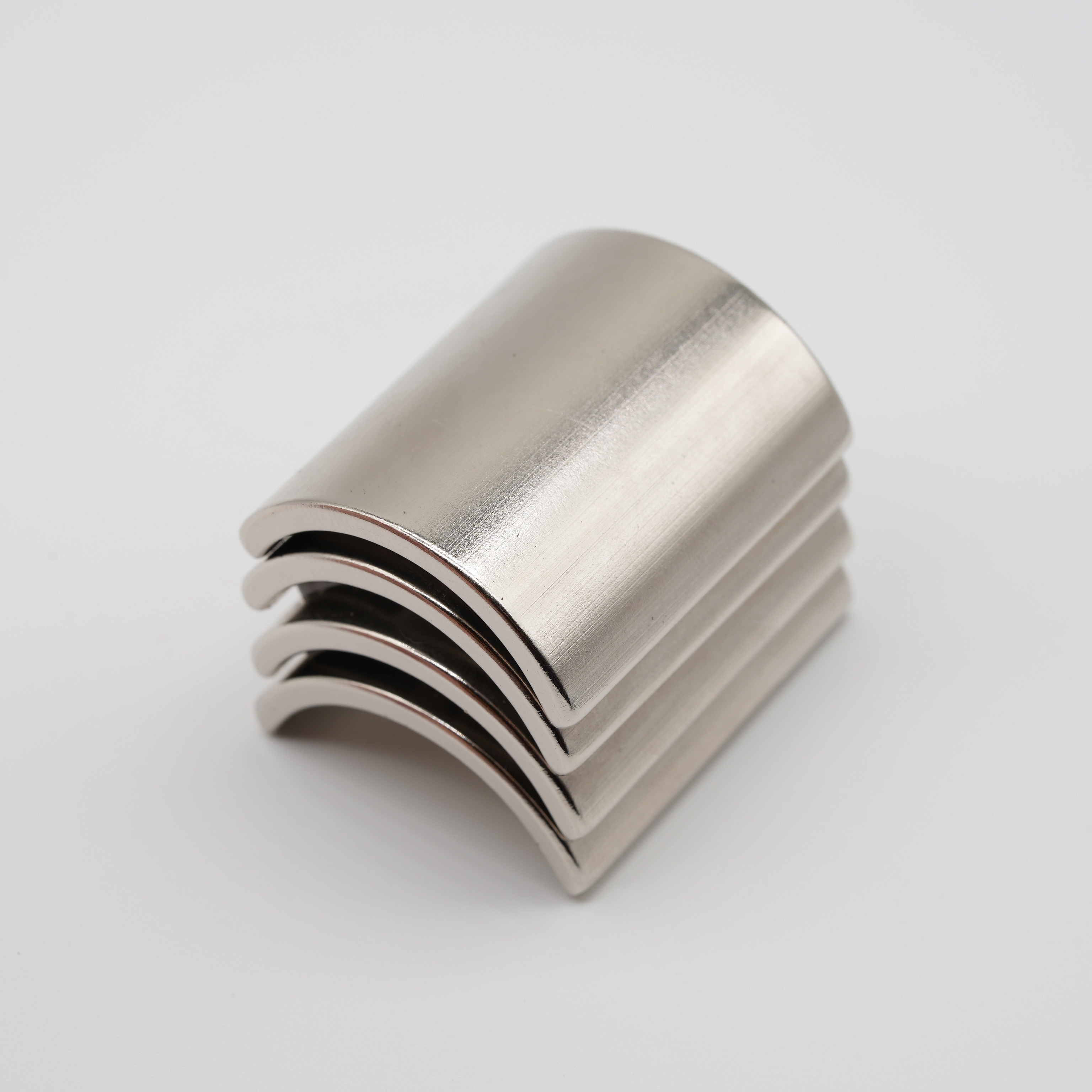
45SH sintered NdFeB arc segment, OR32.5 × IR29 × H24.9 × 60° — the discrete format used in pump, HVAC and auxiliary drive motors.
3. Operating temperature and grade selection
Temperature is where buyers most often compare the wrong numbers. The listed maximum working temperature of a specific catalogue unit is not the ceiling of the format. The 42H multipole ring carries a 120°C figure, yet the same product entry confirms other grades in the format reach 180°C continuous. The 40H radial ring is also listed at 120°C, with grade options from N42H to N40UH reaching 180°C. The 45SH arc segment sits at 150°C continuous.
The full sintered NdFeB grade span in the JLmagnet range runs from N25 to N58, through 33M–56M, 30H–56H, 30SH–56SH, 30UH–54UH, 28EH–48EH and 28AH–42AH, with Br from 0.96 T to 1.47 T and (BH)max from 23 to 53 MGOe. The published maximum working temperatures by family are 70–80°C for N, 100°C for M, 120°C for H, 150°C for SH, 180°C for UH and 200°C for EH.
EH is therefore the highest grade with a published temperature in the standard family table: EH grades reach 200°C, and they are the appropriate specification when a drive motor or a medical device sits in a thermal environment where SH or UH would lose margin. AH grades from 28AH to 42AH are also within the producible range; the general family table does not publish an AH temperature, so an AH requirement should be confirmed in writing against the specific model. Third-party product literature — for example MPCO Magnetics — cites 30AH–33AH grades at up to 220°C, which is useful context but should not substitute for a supplier-confirmed value on your drawing.
How to read a grade claim correctly
Maximum working temperature is a property of the grade, but whether your rotor reaches it depends on the load line and the thermal design of the motor. Ask for the grade, the confirmed maximum working temperature for that grade in your geometry, and the demagnetization margin at the worst-case operating point. A supplier who answers all three is giving you a specification; one who answers only the first is giving you a catalogue line.
4. Certification coverage and its scope
Certification questions are usually asked as a yes-or-no, which is why they produce weak answers. The relevant accreditations for a magnet supplier serving automotive and medical programs are IATF 16949:2016 for the automotive quality system, ISO 9001:2015 for quality management and ISO 14001:2015 for environmental management. JLmagnet holds all three, together with an Intellectual Property Management System certification, and has held IATF 16949 since 2019.
Scope is the part buyers miss. The IATF 16949:2016 certificate covers the manufacturing scope; product design is excluded under Chapter 8.3. This is normal for a magnet manufacturer and it has a direct consequence: if your motor program requires the magnet supplier to own design responsibility for the magnetic circuit, that responsibility must be contracted separately, because the certificate does not carry it.
The practical check is to request the certificate with its scope statement, confirm that the manufacturing site quoted on your PO is the site covered, and clarify in writing who holds design responsibility for the magnet geometry. JLmagnet's technical team supports customers with magnetic circuit simulation, magnetic field analysis and material selection optimization — engineering support that should be described accurately in the contract rather than assumed to be covered by the quality certificate.
For European and North American buyers, a further check is materials compliance. Coatings and material declarations should be confirmed against REACH and RoHS requirements for the specific grade and coating combination you order, since the coating system — not only the magnet alloy — determines part of the compliance picture.
5. Tolerance, coating and inspection
The two ring formats carry ±0.05 mm dimensional tolerance; the 45SH arc segment carries ±0.1 mm. That difference is not a quality ranking — it reflects the fact that a ring is a single part whose concentricity and wall thickness are set in one machining operation, while arc segments are matched in sets.
Standard coating across the three formats is Ni-Cu-Ni. Where the working environment is more aggressive, zinc, nickel, epoxy and parylene coating options are available, and the choice should be made against the actual exposure rather than inherited from a previous project. The supplier's in-house test capability matters here: salt spray corrosion testing and high- and low-temperature damp heat aging are part of the reliability assessment supporting coating and grade decisions.

Salt spray testing supports coating selection for Ni-Cu-Ni, zinc, epoxy and parylene options.
6. Purchasing terms and acceptance criteria
Acceptance criteria are the checkpoint most often left until after the sample is approved. A magnet purchase order that specifies only grade, dimensions and quantity leaves the two variables that cause rejection — magnetization pattern and coating condition — undefined.
A workable acceptance set covers the grade with its confirmed maximum working temperature, the full dimensional stack including tolerance, the coating type and thickness expectation, the magnetization direction and pole count for rings, the inspection method and sampling plan, and the document package required per lot. Magnetic test reports issued per batch, magnetic properties controlled within ±2% fluctuation and a 99.5% key dimensional pass rate are the kind of measurable commitments that can be written into those terms rather than assumed.
Step by step: how to settle the format before the RFQ goes out
- Fix the rotor concept first. Decide whether the rotor receives one ring or a set of segments. This single decision determines the tooling, the balancing method and the assembly station layout, and it should be made before magnetic performance is optimized.
- Derive the pole count from the motor, not from the catalogue. A multipole ring is available with 8 or 12 poles and a radial ring with 4 or 6 poles in the reference units. If your design needs a different pole count, confirm it as a custom requirement rather than assuming a standard part will cover it.
- Work backwards from the hot spot. Establish the worst-case magnet temperature in the application, then select the grade with margin. Use the family temperatures as a starting map — 120°C for H, 150°C for SH, 180°C for UH, 200°C for EH — and confirm the final value for your geometry.
- Check certification scope against the project. Obtain the IATF 16949:2016, ISO 9001:2015 and ISO 14001:2015 certificates with scope statements, confirm they cover the manufacturing site quoted, and note that product design is excluded from the IATF scope under Chapter 8.3.
- Lock tolerance, coating and inspection method together. Choose the coating against the real environment, and specify the inspection method and sampling plan in the same document as the tolerance.
- Validate with a sample against written acceptance criteria. Test the sample against the criteria you intend to use in serial supply, not against a looser set. If the sample passes a stricter test than the PO requires, the PO is the weaker document.
- Fix commercial terms before design freeze. Packaging, lot traceability, document package and change-notification expectations belong in the agreement while the format is still open, because after design freeze they become negotiation points with no leverage.
Comparison at a glance
The table below compares the three reference units on the properties that appear in their published specifications. Values apply to those units and grades, not to every possible configuration of each format.
| Criterion | Multipole ring | Radial ring | Standard sintered NdFeB (arc) |
|---|---|---|---|
| Reference unit | 42H, OD25 × ID16 × H5 mm, 8/12 poles | 40H, OD18 × ID10 × H4 mm, 4/6 poles | 45SH, OR32.5 × IR29 × H24.9 × 60° |
| Magnetization | Multi-pole, one-piece ring | Radially oriented, one-piece ring | Diametrically magnetized arc segment |
| Br | > 1.29 T | > 1.26 T | > 1.33 T |
| Hcj | > 1353 kA/m | > 1353 kA/m | > 1592 kA/m |
| (BH)max | 318–342 kJ/m³ | 302–326 kJ/m³ | 342–366 kJ/m³ |
| Listed max working temperature | 120°C | 120°C | 150°C |
| Dimensional tolerance | ±0.05 mm | ±0.05 mm | ±0.1 mm |
| Standard coating | Ni-Cu-Ni | Ni-Cu-Ni | Ni-Cu-Ni |
| Rotor assembly | Single insertion, no glued joints | Single insertion, replaces spliced segments | Individual segment placement |
Where each format earns its place
Automotive drive and auxiliary motors
Automotive auxiliary EPS motors appear in the application list for both ring formats, which makes them the clearest case for a one-piece ring: the rotor is small, the pole pattern is contained in the magnet, and assembly simplicity translates directly into line throughput. Electric vehicle auxiliary motors appear in the discrete sintered NdFeB application list, reflecting a design pattern where the magnetic circuit is built from defined pole pieces.
For a drive motor program, the useful sequence is to settle the thermal requirement first — an EH grade at 200°C exists precisely because some drive environments will not accept an SH or UH part — then decide whether the rotor architecture supports a ring. A ring at UH grade may solve both problems at once, but only if the rotor was designed for a ring.
Medical devices
Medical applications split along the same lines. High-precision magnetic encoders and precision magnetic speed sensors appear in the application list for both ring formats, and these are the components where a sinusoidal field and stable pole-to-pole consistency matter. N52 sintered NdFeB in disc and ring form is listed for medical device components and precision automation, which is typical of smaller actuator and instrument assemblies.
In medical work the acceptance criteria carry more weight than the headline magnetic figure, because a design change after validation is expensive. Specifying the inspection method, the document package and the coating at the sample stage is more valuable than a marginal gain in (BH)max.
Magnetic coupling and transmission assemblies
Both ring formats are listed for magnetic coupler and magnetic transmission assemblies. A one-piece ring suits this role because the coupling face needs a defined pole pattern across a continuous surface, and because a ring removes the joint lines that a segmented assembly introduces. Custom magnetic coupling geometry is a design question, not a catalogue question, and should be raised with the supplier's engineering team while the coupling architecture is still fluid.
Frequently asked questions
What certification scope should a magnet supplier show for an automotive motor program?
Ask for the certificates themselves, not the certificate numbers: IATF 16949:2016 for the automotive quality system, ISO 9001:2015 for quality management and ISO 14001:2015 for environmental management. Then read the scope. The IATF 16949:2016 certificate covers the manufacturing scope, and product design is excluded under Chapter 8.3. JLmagnet holds all three certifications alongside an Intellectual Property Management System certification, with IATF 16949 held since 2019. If your program needs the supplier to own magnetic circuit design responsibility, that must be contracted as a separate service, because the quality certificate does not include it.
Can multipole and radial ring magnets be specified for 200°C operation?
The ring formats have published grade headroom beyond their reference units. The 42H multipole ring and the 40H radial ring are both listed at a 120°C maximum working temperature as individual units, but their product entries confirm grade options reaching 180°C continuous for the multipole format and N42H to N40UH with up to 180°C for the radial format. For 200°C, the EH grade in the standard sintered NdFeB family is the published reference point, with AH grades from 28AH to 42AH also producible. Because maximum working temperature interacts with the load line and rotor thermal design, the 200°C requirement should be confirmed in writing for the exact geometry rather than inferred from a grade table.
Which format reduces assembly cost?
The one-piece formats remove steps rather than reduce unit price. Both the multipole ring and the radial ring are described as eliminating glued segments, and the radial ring entry states directly that it simplifies the rotor assembly process and saves assembly cost compared with spliced segment magnets. The saving comes from fewer placement operations, no adhesive process and a single balancing reference. Discrete sintered NdFeB segments remain the practical choice where the rotor geometry changes between programs, since each segment can be repositioned without re-tooling a ring.
What should be fixed in writing before a sample order?
Six items: the grade with its confirmed maximum working temperature for your geometry, the full dimensional stack with tolerance (±0.05 mm for the ring formats, ±0.1 mm for the reference arc segment), the coating type, the magnetization direction and pole count for rings, the inspection method and sampling plan, and the document package per lot. Measurable commitments such as magnetic test reports issued per batch, magnetic properties controlled within ±2% fluctuation and a 99.5% key dimensional pass rate give the sample a benchmark to be judged against. A sample approved against looser criteria than the purchase order will not protect serial supply.
What purchasing terms should be agreed before the magnet format is locked?
Agree packaging, lot traceability, document package and change-notification expectations while the format is still open. Lot traceability is not theoretical: JLmagnet operates digital-intelligent workshops with ERP, MES and WMS systems supporting full-lot traceability from raw material input through finished-product delivery, which is the mechanism behind a per-lot test report. Once the rotor tooling is cut, these terms stop being negotiable. Buyers who want to test a candidate format under their own acceptance criteria can request a sample or quotation from the JLmagnet technical team at Sales00@jlmagnet.com, and can review the full material and capability range in the JLmagnet company profile.

Packing and lot documentation — where the acceptance criteria agreed at sample stage become the per-lot record.
Conclusion
The choice between a multipole ring, a radial ring and standard sintered NdFeB segments is a rotor architecture decision wearing the clothes of a material decision. All three use sintered neodymium-iron-boron. What separates them is whether the pole pattern arrives as one part or as a set, and that difference sets assembly steps, concentricity control and the way temperature margin is achieved.
Three checks carry most of the weight. Confirm the format against the rotor concept before magnetic performance is optimized, since reversing it later forces new tooling. Read the temperature requirement from the application hot spot and confirm the grade against your geometry — 120°C for H, 150°C for SH, 180°C for UH, 200°C for EH in the published family table. And read certification scope, not just certification names: IATF 16949:2016 covers manufacturing, with product design excluded under Chapter 8.3, so design responsibility must be agreed separately if your program needs it.
Get those three right and the remaining questions — tolerance, coating, acceptance criteria and lot documentation — become specification work rather than rework. Get them wrong and no grade upgrade will recover the program schedule.
Have Questions or Need More Details?
Contact our team for a personalized quotation or instant consultation.
Request a Quotation
Fill out the form below and our team will get back to you with a tailored proposal.
WhatsApp Direct Chat
Prefer to chat in real-time? Message us on WhatsApp for instant assistance & quick answers.
- Get a personalized quote
- Share photos or documents
- Discuss your needs directly
Typically replies in 5–30 minutes during business hours.