
Long-Term Sintered NdFeB Magnet Supply: Certifications, Grades, and Support FAQ
A sintered NdFeB magnet program that runs for eight years will outlive several purchasing cycles, at least one neodymium price swing, and probably the engineer who first specified the grade. That is why supply questions surface early — during research and supplier evaluation — and why they are rarely about today's price per kilogram. They are about what a supplier's certifications actually cover, which grades it can hold in serial production, and what support exists after the first shipment. This FAQ addresses those questions for buyers of sintered neodymium magnets.
JLmagnet, the trading and brand name of Ningbo Jinlun Magnet Technology Co., Ltd., is a sintered NdFeB magnet manufacturer based in Cixi, Ningbo, China. The company began as Cixi Jiwei Magnetoelectric Material Factory in 1996 and was formally incorporated in 2006, and it exports approximately 30% of its output to Europe, America and other overseas markets. The facts below come from its own production, certification and product records.

Sintering is one of the four in-house process stages that determine whether a NdFeB grade can be repeated lot after lot.
Why Long-Term NdFeB Supply Is Decided at the Research Stage
A long-term sintered NdFeB supply decision is a scope-and-consistency decision, not a price decision. Three failure modes account for most of the problems that appear two or three years into a program:
- Grade drift under thermal load. A magnet specified at the prototype stage on an N or H grade can lose coercivity once the rotor actually runs hot in the field. Recovery usually means moving a full grade family, which changes dimensions, magnetic circuit and sometimes the whole rotor stack.
- Certification scope gaps. An automotive or medical customer assumes the supplier's IATF 16949 certificate covers design and development. When it does not, the design record has to be rebuilt on the buyer's side mid-project.
- Batch inconsistency at volume. A sample lot that measures well is not evidence of serial capability. Without per-batch magnetic testing and dimensional control, the second and third production lots become the real qualification test.
Each of these is cheaper to resolve before the drawing is frozen than after. That is the practical reason this topic belongs to research and evaluation rather than to procurement execution.
Industry Background: Where NdFeB Capacity and Price Risk Sit
Sintered NdFeB supply is geographically concentrated, and the concentration is not a short-term condition. According to the International Energy Agency, China's share of global sintered permanent magnet production reached 94% in 2024. Research and Markets, citing GlobeNewswire, estimates the global NdFeB magnet market at USD 17.3 billion in 2025, and Chinese exports of permanent magnets under HS code 850511 were valued at USD 3.24 billion in 2024 according to the World Integrated Trade Solution.
Raw-material pricing adds the second variable. One secondary market source, Strategic Metals Invest, reports neodymium prices rising 64.03% year-to-date in 2026 to USD 244.90 per kilogram by September. Buyers do not need to accept any single price forecast to draw the operational conclusion: a magnet grade that is cheap to sample can be expensive to re-source, because re-qualifying a new supplier typically means re-running thermal, corrosion and dimensional validation.
Demand intensity reinforces the same point. Persistence Market Research estimates that each megawatt of offshore wind capacity requires approximately 200–600 kg of high-performance NdFeB magnets. Programs of that scale are planned in years, not quarters, so the supplier relationship has to be planned on the same horizon.
The practical takeaway: in a concentrated supply base with volatile rare-earth input costs, long-term magnet supply is secured through documented grade capability, certified process control and traceable batch records — not through a single low quotation.
The JLmagnet Certification Set and What Each Certificate Covers
Certification is only useful to a buyer if the scope is read, not just the logo. JLmagnet holds four credentials that matter at the evaluation stage.
IATF 16949:2016 — the automotive quality system
JLmagnet has held IATF 16949 certification since 2019. For an automotive drive motor or auxiliary motor program, this is the certificate that governs process control discipline: control plans, PFMEA, calibration, corrective action and lot traceability. It is the certificate most often requested by tier-one suppliers and by OEM quality departments before a magnet drawing is released for quotation.
ISO 9001:2015 and ISO 14001:2015
ISO 9001:2015 covers the general quality management system across the whole product range and applies to buyers outside the automotive sector — industrial servo motor builders, medical device OEMs, sensor manufacturers and magnetic coupling designers. ISO 14001:2015 covers environmental management and is increasingly requested in European supplier questionnaires, where magnet buyers are asked to document environmental controls alongside material declarations. The company also holds an Intellectual Property Management System (IPMS) certificate and more than 60 invention and utility-model patents covering magnet formulation, grain-boundary diffusion, machining processes and tooling.
The Chapter 8.3 exclusion: manufacturing, not product design
This is the single most misunderstood point in magnet supplier qualification, so it deserves a direct answer: JLmagnet's manufacturing scope excludes product design and development, corresponding to Chapter 8.3 of the IATF 16949 standard. In practice, the company manufactures to the customer's drawing and specification.
What that means for a buyer:
- Design responsibility stays with you. Magnetic circuit design, DFMEA, design validation and the design record remain on the customer's side. The supplier does not issue design validation on your behalf.
- Your RFQ pack has to be complete. Grade, dimensions and tolerances, magnetization direction and pole pattern, coating, working temperature, and the acceptance criteria for magnetic properties all need to be in the drawing or specification attached to the inquiry.
- Process documentation is still provided. The supplier side covers process control, inspection, magnetic property testing and dimensional verification — the manufacturing evidence, not the design evidence.
- Engineering support is a service, not a design record. JLmagnet's technical team provides magnetic-circuit simulation, magnetic-field analysis and material-selection optimization as support to the buyer's engineers. Useful during evaluation, but the resulting design decision remains the buyer's.
The exclusion is not a limitation to work around; it is a boundary that clarifies who signs what. Programs that understand it early avoid the common delay where a customer discovers mid-PPAP that the design record was never transferred.

In-house salt-spray and high-temperature aging testing supports coating and durability claims with recorded results rather than assumptions.
Grade Coverage and Thermal Headroom for Motor and Medical Programs
Grade range is where a long-term supply commitment is either credible or not. Product record 9216 in the JLmagnet catalogue defines the sintered NdFeB envelope:
- Grade families: N25–N58, 33M–56M, 30H–56H, 30SH–56SH, 30UH–54UH, 28EH–48EH, 28AH–42AH.
- Remanence (Br): 9.6–14.7 kGs (0.96–1.47 T).
- Intrinsic coercivity (Hcj): ≥12 kOe for N and M, ≥16 kOe for H, ≥20 kOe for SH, ≥25 kOe for UH, ≥30 kOe for EH.
- Maximum energy product (BH)max: 23–53 MGOe.
- Maximum working temperature: 70–80°C (N), 100°C (M), 120°C (H), 150°C (SH), 180°C (UH), 200°C (EH).
Above EH, published grade data for AH-family magnets such as 30AH–33AH indicates operating capability up to 220°C. AH grades sit at the top of the thermal ladder and are specified only where the magnetic circuit genuinely requires that headroom, because the heavy rare-earth content that delivers it carries a cost penalty.
| Grade family | Max working temperature | Hcj (minimum) | Typical evaluation context |
|---|---|---|---|
| N | 70–80°C | ≥12 kOe | Consumer electronics, holding and sensor functions, low thermal load |
| M | 100°C | ≥12 kOe | Appliance motors, small BLDC drives, encoders |
| H | 120°C | ≥16 kOe | Servo motors, EPS auxiliary motors, automation spindles |
| SH | 150°C | ≥20 kOe | Industrial pumps, HVAC fans, compressor motors |
| UH | 180°C | ≥25 kOe | High-temperature servo and traction auxiliary drives |
| EH | 200°C | ≥30 kOe | Automotive drive motors, medical device assemblies, aerospace components |
| AH | up to 220°C (published grade data, 30AH–33AH) | Not stated in product record 9216 | Highest thermal headroom; confirm grade and circuit together |
Two cautions belong with that table. First, maximum working temperature is a material-level figure; the real limit depends on the magnetic circuit, permeance coefficient, demagnetizing field and duty cycle, so it must be validated in the actual assembly. Second, a higher grade family does not automatically mean a better magnet — moving from SH to EH usually reduces available remanence at the same energy product, so the correct grade is the lowest one that survives the thermal envelope with margin.
Typical examples inside the record: an N52 grade reaching (BH)max of 398–422 kJ/m³ with a maximum working temperature of 80°C, well suited to compact consumer and automation assemblies; a 45SH segment measuring OR32.5 × IR29 × H24.9 × 60° with Br above 1.33 T, Hcj above 1592 kA/m and a 150°C working limit, sized for permanent magnet motor assembly; and grades up to 48EH within the EH family for 200°C drive motor duty.
Shapes, magnetization and assembly fit
Thermal capability is only half of a supply discussion; geometry decides whether the magnet can be assembled at rate. Product record 9216 covers discs and cylinders, rings, blocks, arcs (tiles), trapezoids, multipole radial rings, Halbach components and custom shapes. The naming code is D for disc or column, F for block and R for arc, followed by dimensions, with features such as steps, holes or chamfers appended after a hyphen — for example D15×3.8 for a disc, D50×D13.5×20-D20×8 for a ring with counterbore, or R90×R85×40×50 for an arc.
For rotor work, integrated radially oriented rings and one-piece multipole rings remove the segment-gluing step and improve concentricity and dynamic balance. Standard ring families are held to ±0.05 mm dimensional tolerance. Buyers should note that this article covers sintered NdFeB only; bonded neodymium magnets are a different process route and are not part of the product record discussed here.
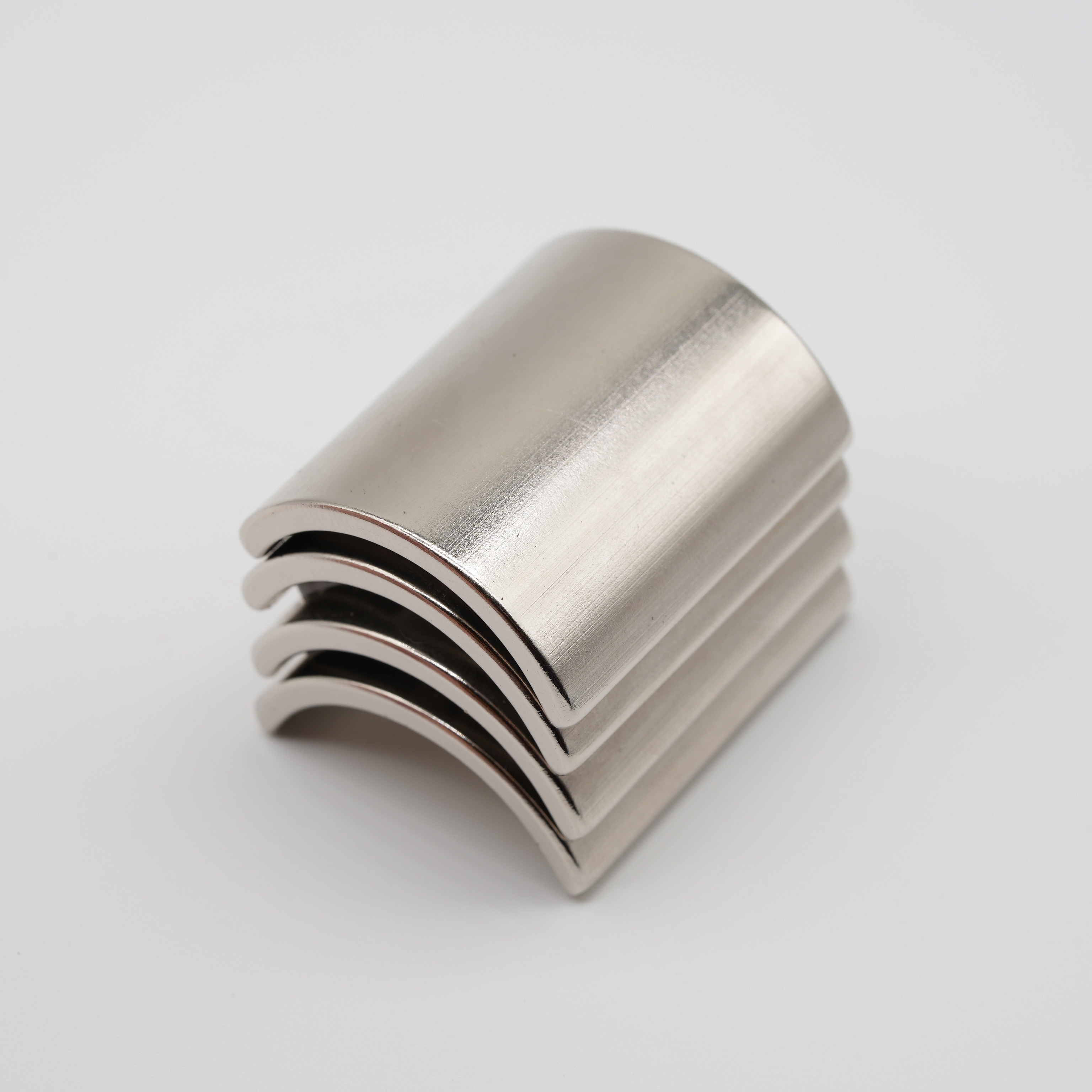
Arc and segment geometries are cut and ground in-house, which is what allows tolerance and coating to be controlled as one process rather than two.
Capacity, Traceability and Batch Consistency
Quantity commitment is the part of a supply agreement that is easiest to promise and hardest to prove. The verifiable figures for JLmagnet are an annual production capacity of 8,000 tons of high-performance magnets, a factory area of approximately 80,000 m², more than 400 employees and a 45-person R&D team, with monthly output typically above 600 tons depending on order mix.
The more decision-relevant number is consistency. Magnetic properties are controlled within ±2% fluctuation, the key dimensional pass rate is 99.5%, and a magnetic test report is issued per batch. Production runs on digital-intelligent workshops supported by ERP, MES and WMS systems, giving full-lot traceability from raw material input through to finished-product delivery — the mechanism that makes a batch report meaningful years later, when a customer audits a specific shipment.
Vertical integration covers melting, hydrogen decrepitation, powder preparation, pressing, sintering, precision CNC machining, multiple surface-treatment routes and final performance testing, with an in-house R&D test centre for rare-earth raw-material inspection, in-process monitoring and reliability testing including salt-spray corrosion and high-temperature aging. Surface options include zinc, nickel, epoxy and parylene coatings, which matters in humid, saline or medical cleaning environments where coating choice determines service life more than grade does.

Final performance testing is where per-batch magnetic reports originate; it is also the stage most often skipped by trading-only suppliers.
How to Qualify a Sintered NdFeB Supplier in Six Steps
The sequence below is written for a research-to-evaluation buyer who expects the relationship to last beyond one program.
Step 1 — Fix the operating envelope before the grade
Define maximum magnet temperature in service, expected demagnetizing field, duty cycle, humidity and cleaning exposure. These five inputs decide the grade family and the coating, and they must be written down before any quotation is comparable.
Step 2 — Read the certificate scope, not the certificate
Confirm the IATF 16949 certificate is current, identify the certified site, and check whether design and development (Chapter 8.3) is inside or outside scope. For JLmagnet it is explicitly outside scope, so plan the design record on your side and expect process documentation from the supplier.
Step 3 — Request samples at the real grade, not a substitute
A sample at a lower grade proves nothing about a 200°C application. Ask for the exact grade family and coating combination, and ask for the magnetic test report that accompanies it.
Step 4 — Test batch-to-batch behaviour, not just the sample
Compare magnetic properties and key dimensions across at least two production lots. This is where a declared ±2% magnetic control and a 99.5% dimensional pass rate can be verified or disproved.
Step 5 — Agree the commercial frame in writing
Minimum order quantity, sample and series lead times, capacity allocation and the mechanism for handling rare-earth price movement. The commercial frame protects the technical decision; without it, a validated grade can still become unsupplyable.
Step 6 — Set the change-control protocol
Define what triggers requalification: source change of rare-earth raw material, coating process change, tooling renewal, or a shift in sintering parameters. A supplier with full-lot traceability can answer these questions with records; one without cannot answer them at all.
Where Long-Term Supply Matters Most
Automotive drive motors and auxiliary motors
Drive motor programs combine high operating temperature, long duty cycles and automotive quality documentation. EH-family grades rated to 200°C, supplied as arcs, segments or radially oriented rings, are the standard fit, with IATF 16949 process control and per-batch magnetic reports supporting PPAP-level evidence. JLmagnet supplies OEM and integrator manufacturers in the automotive, robotics and wind power industries, and has held IATF 16949 certification since 2019.
Medical devices
Medical assemblies typically trade thermal extremes for precision: tight dimensional tolerance, stable magnetic output, and coatings that suit repeated cleaning. Sintered NdFeB magnets are used in the medical device field alongside imaging, pumps and sensor assemblies, where corrosion-resistant surface plating and high dimensional accuracy are the stated application requirements. Documentation is usually the deciding factor — batch-level magnetic and dimensional records matter more than a data sheet.
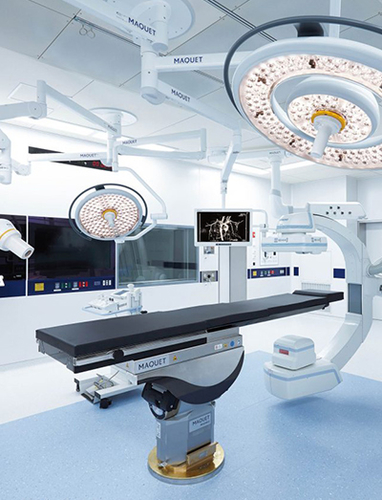
Medical assemblies prioritise dimensional accuracy and coating integrity over maximum energy product.
Industrial servo motors and automation
Servo and actuator duty is cyclic rather than continuous, which changes the thermal profile and often allows an H or SH grade instead of EH. Integrated multipole and radial rings reduce assembly steps and improve torque ripple behaviour in small BLDC servo motors, magnetic encoders and high-speed spindle motors.
Wind power generation
Generator magnets run continuously for years, and material intensity is high — approximately 200–600 kg of high-performance NdFeB per megawatt of offshore capacity. Here the long-term question is not grade alone but capacity reservation and lot traceability across a multi-year build schedule.
Comparison: What to Verify, and What JLmagnet Documents
The table below converts the evaluation criteria into verifiable supplier evidence. It is a checklist, not a ranking.
| Evaluation dimension | What the buyer should ask | JLmagnet documented position |
|---|---|---|
| Automotive certification | Is IATF 16949 current, and does the scope include design? | IATF 16949 since 2019; scope excludes product design and development (Chapter 8.3) |
| General quality system | ISO 9001 certificate and certified site | ISO 9001:2015 |
| Environmental management | ISO 14001 for EU supplier questionnaires | ISO 14001:2015 |
| IP and process ownership | Patents and process know-how | IPMS certification; more than 60 invention and utility-model patents |
| Thermal grade ceiling | Highest grade in serial production | EH family 28EH–48EH to 200°C; AH family listed in record 9216, up to 220°C per published AH grade data |
| Batch consistency | Magnetic property tolerance and report frequency | Magnetic properties controlled within ±2%; magnetic test report per batch |
| Dimensional capability | Key dimension pass rate and tolerance | 99.5% key dimensional pass rate; ±0.05 mm on standard ring families |
| Process integration | Which stages are in-house | Sintering, machining, plating and testing all in-house |
| Capacity | Monthly and annual tonnage | 8,000 tons annual capacity; monthly output typically 600+ tons depending on order mix |
| Minimum order | MOQ for trial and series orders | 10 kg, with sample orders handled separately |
| Sample lead time | Working days for regular samples | 10 days for regular samples |
| Series lead time | Working days for regular batches | 25 days for regular batches |
| Engineering support | Simulation and material selection availability | Magnetic-circuit simulation, magnetic-field analysis and material-selection optimization support |
| After-sales | Technical support and warranty terms | Technical and product support provided; specific warranty and return terms confirmed with sales |
One dimension is deliberately absent: unit price. Sintered NdFeB pricing moves with neodymium and dysprosium content, grade family, coating and geometry, so a durable comparison has to be made on a defined drawing at a defined grade — which is the reason the evaluation steps above put the operating envelope before the quotation.
FAQ: Long-Term Sintered NdFeB Supply
Is JLmagnet IATF 16949 certified, and does the certificate cover magnet design?
Yes, JLmagnet has held IATF 16949 certification since 2019, alongside ISO 9001:2015 and ISO 14001:2015. The certification covers manufacturing, and the scope explicitly excludes product design and development under Chapter 8.3. The practical consequence is that the magnet is built to the customer's drawing and specification, with process control, inspection and per-batch magnetic testing on the supplier side, while the design record, DFMEA and design validation remain with the buyer.
Can JLmagnet supply neodymium magnets for EV motor projects that run at 200°C?
Grades through the EH family, from 28EH to 48EH, are listed with a maximum working temperature of 200°C and an intrinsic coercivity of at least 30 kOe, which is the range normally specified for automotive drive motors that must resist demagnetization at high rotor temperature. Above that, AH-family grades such as 30AH–33AH are published as capable of up to 220°C. Arc, segment, radially oriented ring and multipole ring geometries are all produced in-house, so a drive motor program can be supplied as rotor-ready parts rather than loose magnets. Because grade selection is circuit-dependent, the working temperature should be confirmed against the specific assembly rather than the data sheet alone.
What is the minimum order quantity, and how should long-term pricing be structured?
The minimum order quantity is 10 kg, with sample orders handled separately and confirmed as needed. Long-term pricing is quoted per project rather than published, because cost is driven by grade family, rare-earth content, geometry, tolerance and coating. For multi-year programs the more useful commercial structure is a defined specification plus an agreed mechanism for handling rare-earth movement, backed by a supplier with its own sintering, machining, plating and testing operations, since outsourcing gaps are where both cost and lead time become unpredictable.
How long does a sample take, and what comes with it?
Regular samples are quoted at 10 days. A sample set should be requested at the exact grade family and coating intended for production, together with the magnetic test report covering Br, Hcb, Hcj and (BH)max, plus dimensional inspection results for the critical features. JLmagnet operates an in-house test centre for magnetic property validation and supports salt-spray corrosion and high-temperature aging assessment, which is the evidence a buyer needs before committing a drawing to a grade.
What lead time and capacity can a series program rely on?
Regular batch lead time is 25 days, against an annual production capacity of 8,000 tons of high-performance magnets and monthly output that typically exceeds 600 tons depending on order mix. Delivery is confirmed per order, and full-lot traceability from raw material to finished product is maintained through the ERP, MES and WMS systems. Buyers planning a multi-year build should raise capacity allocation at the evaluation stage rather than after the first purchase order. To start that conversation, send the drawing, grade, coating and annual volume to sales00@jlmagnet.com.
Conclusion
Long-term sintered NdFeB supply is settled by three verifiable things: a certification scope you have actually read, a grade family that survives your thermal envelope in serial production, and process evidence that repeats lot after lot. JLmagnet's position on each is documented — IATF 16949 since 2019 with design excluded under Chapter 8.3, EH grades to 200°C with AH grades listed above that, magnetic properties controlled within ±2% with a test report per batch, 8,000 tons of annual capacity, and in-house sintering, machining, plating and testing behind it.
The remaining work is on the buyer's side: define the operating envelope, put a complete specification in the RFQ, and verify consistency across two production lots before the drawing is frozen. That sequence turns a magnet purchase into a supply relationship that can be audited years later.
Next Step: Sample, Quote or Catalogue
Send your grade, geometry, coating and annual volume for a project-specific quotation, or request a sample set at the exact grade you intend to run. The full company and product profile is available for download.
Download the JLmagnet Profile (PDF)Visit jlmagnet.comEmail: Sales00@jlmagnet.com | Tel: +86-574-6321 2222 | WhatsApp: +86 17621550719 | No. 330 Xinxing 1st Road, Xinxing Industrial Park, Zonghan Street, Cixi City, Zhejiang Province, China
Scope note: the figures in this article describe sintered NdFeB magnet material capability and manufacturing evidence. Final grade, coating and geometry selection must be validated against the specific magnetic circuit, duty cycle and acceptance criteria of each project.
Have Questions or Need More Details?
Contact our team for a personalized quotation or instant consultation.
Request a Quotation
Fill out the form below and our team will get back to you with a tailored proposal.
WhatsApp Direct Chat
Prefer to chat in real-time? Message us on WhatsApp for instant assistance & quick answers.
- Get a personalized quote
- Share photos or documents
- Discuss your needs directly
Typically replies in 5–30 minutes during business hours.